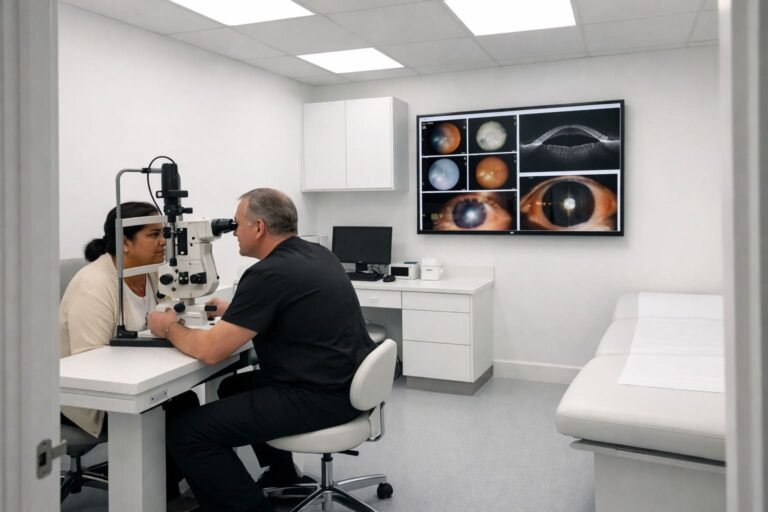
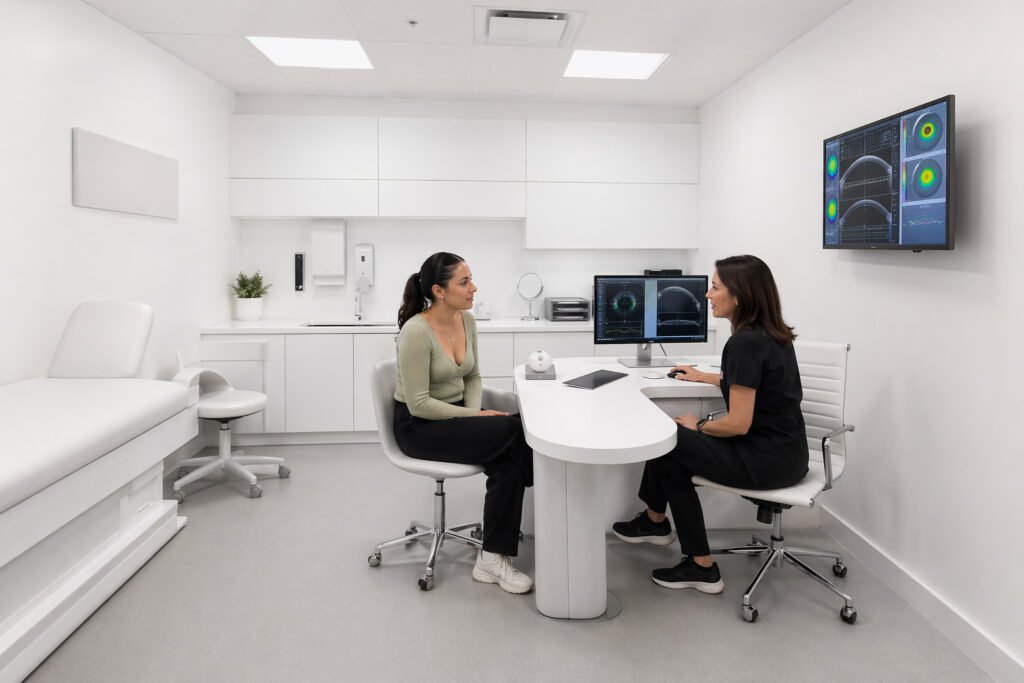
Is ICL or LASIK usually better for high prescription or dry eyes?
High prescriptions or dry eyes often move the discussion beyond LASIK alone. We usually compare LASIK, ICL, TransPRK and lens replacement with your corneal thickness, tear film, prescription stability, internal eye space and age. ICL is often worth discussing, but the right answer comes from measurements, not preference.
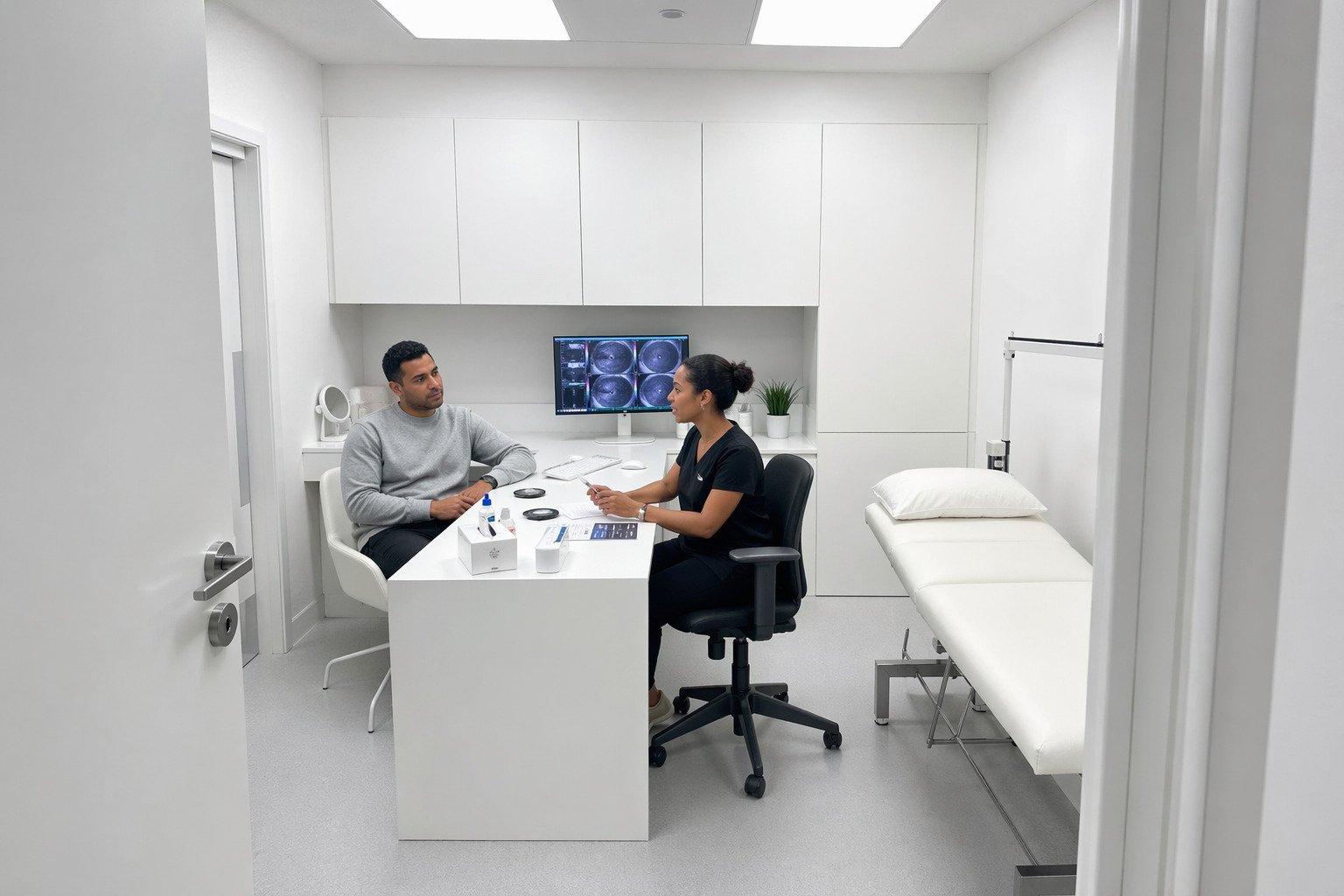
LASIK and ICL solve the same problem in different ways
Laser-Assisted In Situ Keratomileusis, known as LASIK, changes vision by reshaping the cornea, which is the clear front window of the eye. An Implantable Contact Lens, also called an Implantable Collamer Lens in device terminology, changes focus by placing a lens inside the eye while leaving the natural lens in place.
That difference matters if your prescription is high, your corneas are thin, or your eyes already feel dry. LASIK depends heavily on the cornea being suitable. ICL leaves the corneal shape alone, but it is still surgery inside the eye, so it needs its own careful checks.
Here is the practical comparison we use when someone is weighing ICL vs LASIK.
| Option | What it changes | Where it may fit well | Main cautions |
|---|---|---|---|
| LASIK | Reshapes the cornea under a thin flap | Suitable eyes with stable prescriptions, healthy corneas and a good tear film | Dry eye risk, corneal thickness, glare, halos and night vision symptoms |
| TransPRK | Reshapes the surface of the cornea without making a flap | Some thinner corneas or cases where a flap-based treatment is less suitable | Recovery can differ from LASIK and the cornea still needs to be suitable |
| ICL | Places a lens inside the eye without removing the natural lens | Higher myopia, some thin corneas and some dry eye concerns | Eye pressure, lens position, glare, halos, endothelial cell health and possible further surgery |
| Lens replacement surgery | Replaces the natural lens with an artificial lens | Some older patients, early lens ageing or cases where reading vision needs matter | Different operation, different lens choices and a separate risk discussion |
The U.S. Food and Drug Administration approval record describes the EVO/EVO+ Visian Implantable Collamer Lens as a phakic intraocular lens, meaning a lens used in an eye that still has its natural lens. Its device indication includes myopia from -3.0D to -20.0D in stated categories, but that does not replace a UK clinical assessment for your eyes.
Astigmatism also needs a proper check. A toric ICL is made to correct astigmatism as part of the prescription, but rotation, lens sizing and internal eye space still matter. A procedure can look right on paper and still be the wrong choice after the scans.
Get a careful evaluation of your prescription, corneal shape and tear film to see which option may suit you best. Mr Mukherjee sees every patient personally in Colchester.
Book a Free ConsultationThe measurements decide the treatment
A high prescription alone does not tell us whether LASIK, ICL, TransPRK or lens replacement fits. We need to know what your cornea, tear film, prescription history and internal eye anatomy will safely support.
At The Vision Surgeon, we use corneal topography, which maps the front of the eye, and wavefront analysis, which checks how light travels through the eye, as part of the in-person assessment. Those scans help us compare the full range of options instead of treating LASIK and ICL as a simple either-or choice.
The main checks include:
- Prescription stability. A prescription that is still changing makes any vision correction plan less predictable. The U.S. Food and Drug Administration also flags stable refraction, high or low refractive error, corneal thickness and tear production as LASIK screening points.
- Corneal thickness and shape. LASIK removes corneal tissue as it reshapes the eye, so a thin or irregular cornea can push the discussion to TransPRK, ICL or lens replacement.
- Tear film health. Dry eye is a real suitability factor. We look for dry eye symptoms before recommending laser treatment because the surface of the eye has to cope well after surgery.
- Internal eye space matters for ICL. Device criteria for EVO ICL include an anterior chamber depth, the space at the front of the eye, of at least 3.00 mm, along with a stable refractive history within 0.5D for one year before implantation. We use that kind of measurement as part of a wider clinical decision, not as a shortcut.
- Contact lens intolerance. Trouble wearing contact lenses does not automatically rule out ICL because the lens is not worn on the eye surface. The cause of the intolerance still needs checking, especially if dryness or inflammation is involved.
Age can change the answer
Age can move the decision away from both LASIK and ICL. If you are in the over-45 or over-50 group, we also think about lens ageing, early cataract and reading vision.
Refractive lens exchange, also called lens replacement surgery, replaces your natural lens with an artificial lens to correct focus. That route can make more sense when your natural lens is already starting to change, or when a plan needs to deal with distance and reading vision together. Mr Hatch Mukherjee’s Royal College of Ophthalmologists Certificate in Laser Refractive Surgery, called CertLRS, is relevant here because the judgement is not just which operation is possible, but which operation matches the eye in front of us.
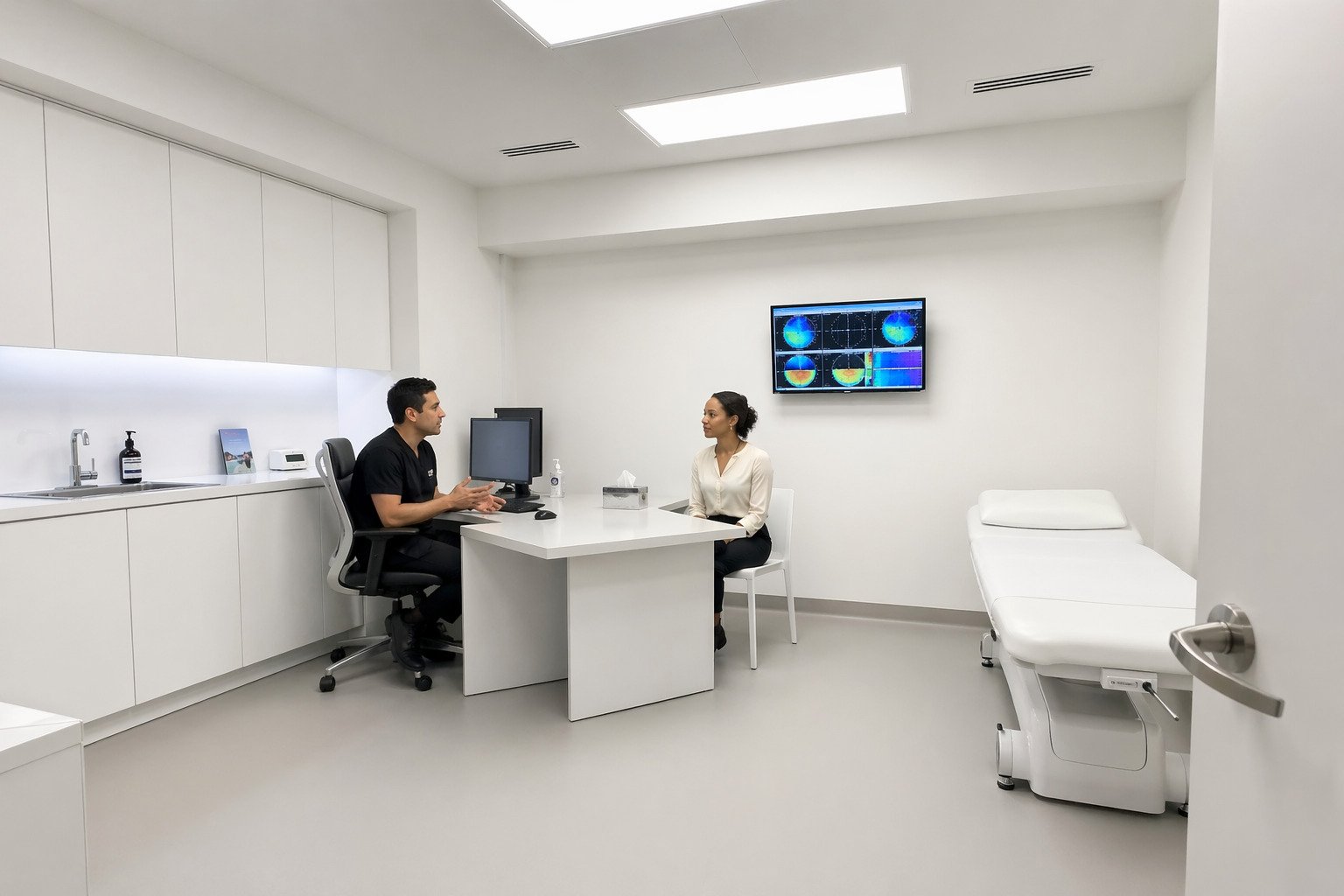
A high prescription alone does not decide suitability. Corneal thickness, tear film health and internal eye measurements often matter more than the glasses number.

Risks, recovery and cost belong in the same conversation
Two people can arrive with similar glasses prescriptions and leave with different recommendations. One may have a thick, regular cornea and a healthy tear film. The other may have dry eyes, a thinner cornea or internal eye measurements that make ICL a better discussion.
Dry eye deserves direct attention. LASIK can worsen existing dry eyes, and chronic dry eyes can develop after surgery in someone who did not have dry eyes before. That does not mean LASIK is wrong for every person with dryness, but it does mean we assess and manage the eye surface before making a decision.
Night vision also belongs in the risk discussion. LASIK risk information should include glare, halos, starbursts, night-driving difficulty and reduced contrast sensitivity in dim light. ICL can also be associated with glare or halos, so we do not present either operation as free from optical side effects.
ICL-specific risks are different because ICL is intraocular surgery, which means surgery inside the eye. We discuss eye pressure, lens position, endothelial cell health, which refers to the delicate inner layer of the cornea, and the possibility that further surgery could be needed. ICL can be removed or exchanged by surgery in some situations, but that does not make the original procedure consequence-free.
Cost should sit after suitability, not ahead of it. The Vision Surgeon’s 2026 indicative price range for LASIK or TransPRK is £1,400 to £1,800 per eye, with final pricing confirmed after assessment. ICL is about £3,000 per eye, and published pricing includes consultation, surgery and standard aftercare appointments. Where lens replacement is the better fit, the indicative range is £2,000 to £4,000 per eye depending on lens type.
Price tells you what procedure you are buying, but suitability tells you whether you should be buying it at all.
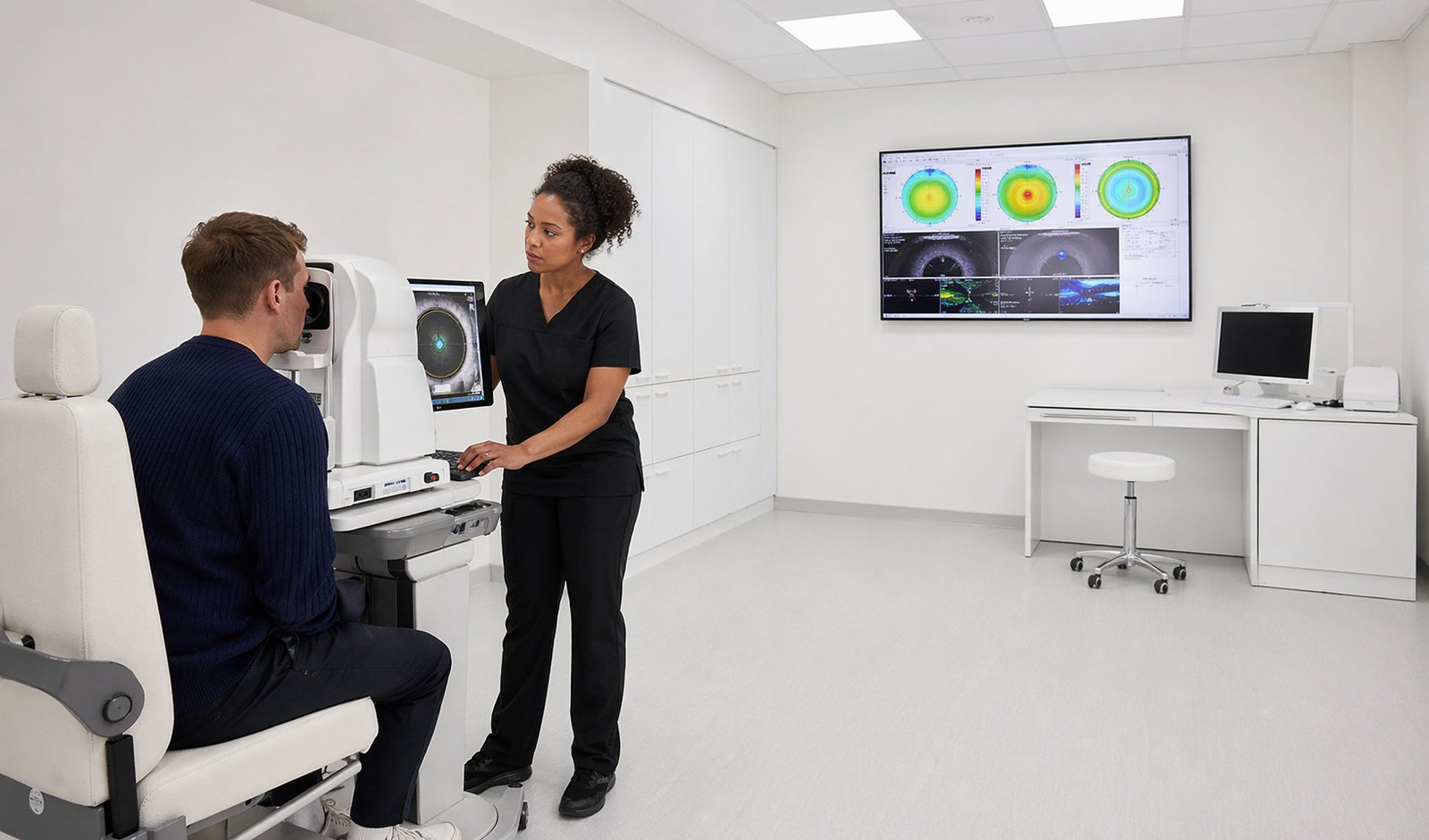
Dry eye symptoms should be discussed before any laser treatment. In many cases, that changes the conversation towards ICL, TransPRK or lens replacement surgery.
A clearer decision in Colchester
Once the measurements are on the table, the question changes. You are no longer trying to decide whether ICL sounds better than LASIK. You are checking whether your cornea, tear film, prescription stability, internal eye space and age point to laser, an internal lens or lens replacement surgery.
That is especially useful if you live in Essex, Suffolk or nearby areas and have already had mixed advice. A borderline LASIK candidate should not be squeezed into laser surgery because that is the only treatment on offer. At The Vision Surgeon, we compare LASIK, TransPRK, ICL and lens replacement in Colchester, and Mr Mukherjee personally performs procedures and provides follow-up appointments.
Local continuity matters in a practical way. Being assessed by the same consultant who treats you reduces the gap between the recommendation and the operation day, and it keeps aftercare tied to the original clinical reasoning. For high prescription eye surgery in Essex or vision correction near Suffolk, that can be the difference between a vague “you may be suitable” and a clear plan based on your own measurements.
The useful shift is simple: prescription stops being the deciding label, and your measured eye health becomes the test. Once you know what to check, LASIK, ICL, TransPRK and lens replacement become clinical options to compare properly, not names to choose from a menu.
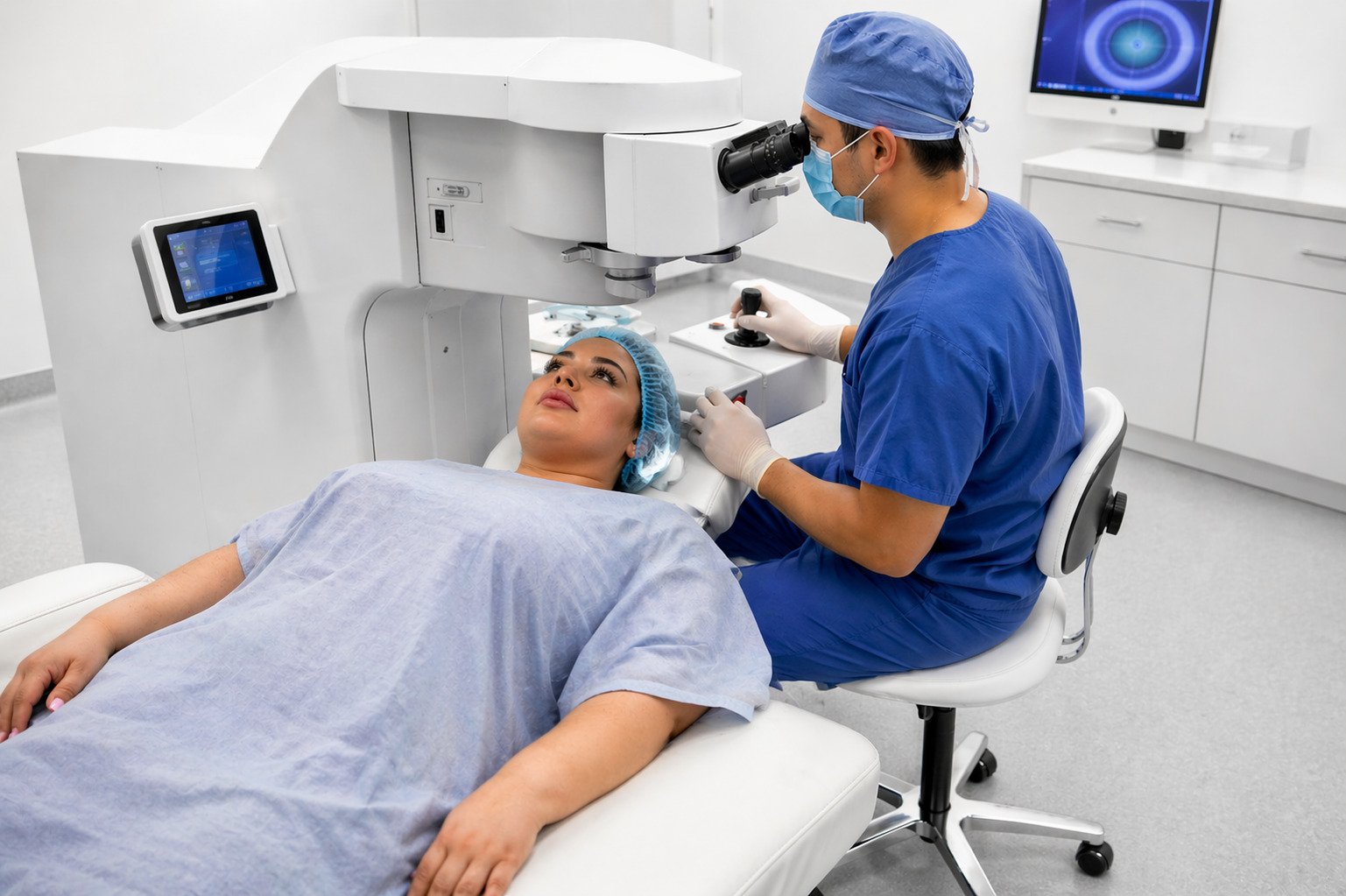
If you are weighing up ICL, LASIK or TransPRK, a short eligibility check can help you decide whether a full assessment is worthwhile.
Take the Eligibility QuizQuestions we get asked about ICL and LASIK
Can ICL correct astigmatism?
A toric ICL is made to correct astigmatism as part of treating myopia in suitable eyes. We still need to check lens sizing, lens position and the shape of your eye before recommending it.
Does ICL cause dry eyes?
ICL does not reshape the cornea in the same way as laser eye surgery, so we often discuss it when dry eye is a concern. Dry eye still needs assessment before any refractive procedure, because comfort and surface health affect the overall plan.
Can I have ICL if I cannot wear contact lenses?
Contact lens intolerance does not automatically rule out ICL because the lens is placed inside the eye and is not worn on the surface. We need to know why contact lenses have become difficult, especially if dry eye or irritation is part of the problem.
What happens if my prescription has changed recently?
A changing prescription can delay surgery because the result is harder to plan. We check prescription history as part of suitability, and we do not treat the glasses prescription as a stand-alone decision.
Do I need to travel to London for ICL or LASIK assessment?
You do not need to assume London is the only route for consultant-led vision correction. Assessment, surgery and follow-up can be handled locally in Colchester for suitable patients from Essex, Suffolk and surrounding counties.
This is general information, not medical advice.