Which eye surgery usually suits a strong glasses prescription?
A strong glasses prescription does not automatically rule out eye surgery. The right option depends on the type of refractive error you have, how high it is in dioptres, the shape and thickness of your cornea, your age, and the health of your natural lens. For some people, laser treatment is suitable. For others, an implantable contact lens or lens replacement offers a better fit.

What does it actually mean to have a “strong” prescription for glasses?
You probably know the feeling already. Your lenses look thick at the edges, your glasses cost more than standard pairs, and a small change in prescription can make everyday vision feel noticeably different.
Optometrists usually describe a prescription as stronger when the refractive error sits well outside the mild to moderate range. That may mean high myopia, which is short-sightedness, significant hyperopia, which is long-sightedness, or marked astigmatism, where the front of the eye has an uneven curve. Prescriptions are measured in dioptres, and that number matters because it affects how much correction surgery would need to provide.
A “strong” prescription is not one single cut-off. Surgical planning looks at the whole pattern, including sphere, cylinder, stability, and eye health. Someone with moderate short-sightedness and severe astigmatism may need a very different approach from someone with high myopia alone.
Many people assume strong prescription eyes are simply too high to treat. That is a common misunderstanding. In practice, the question is usually not whether treatment exists. The real question is which procedure can correct the vision safely and predictably within the natural limits of the eye.
Standards set by regulated eye care professionals, including those working under the General Optical Council, focus on accurate measurement and safe referral. Guidance from bodies such as the Royal College of Ophthalmologists also reflects the fact that prescription strength is only one piece of suitability, not the whole answer.
Discuss your vision goals with our experienced consultant and receive a thorough personal assessment.
EnquireHow does prescription strength limit or expand your surgery options?
Some procedures do have limits. That is the honest starting point.
Laser eye surgery works by reshaping the cornea, so the stronger the prescription, the more tissue may need to be treated. Once a prescription reaches a certain level, the surgeon has to ask whether enough healthy corneal tissue would remain afterwards. Corneal thickness, corneal shape, dryness, and prescription pattern all influence that decision.
With LASIK, a thin flap is created before the laser reshapes the cornea. LASIK can treat many people very effectively, but very high prescriptions can push it beyond the safest range for some eyes. TransPRK, a surface laser treatment with no flap, may suit certain corneas better, yet it still depends on how much reshaping the eye can tolerate.
If laser surgery is out of range, that does not close the door. It often shifts the discussion to procedures that do not rely on removing corneal tissue. An implantable contact lens, or ICL, places a lens inside the eye to correct vision and can be especially relevant in high myopia correction. Lens replacement surgery, also called refractive lens exchange, removes the natural lens and replaces it with an artificial one chosen for the prescription.
Picture two patients with similarly strong glasses. One has high myopia with a thick, healthy cornea and a stable prescription. Laser treatment may still be possible. Another has a slightly lower prescription but thin corneas and dry eyes. That second patient may be a better fit for ICL despite having a smaller glasses number.
Age changes the picture as well. Once reading vision starts to change or early cataract changes appear, lens replacement suitability becomes more relevant. A person in their twenties with strong myopia may lean toward ICL. A person in their fifties with a similar prescription may be better served by lens replacement because it can address both distance correction and the age-related lens changes that glasses alone can no longer solve neatly.
That is why proper eligibility matters more than headline prescription thresholds. A consultant with refractive training, including CertLRS level expertise and broader lens surgery experience, looks at what your eyes can support safely, not just what a chart says they should tolerate.
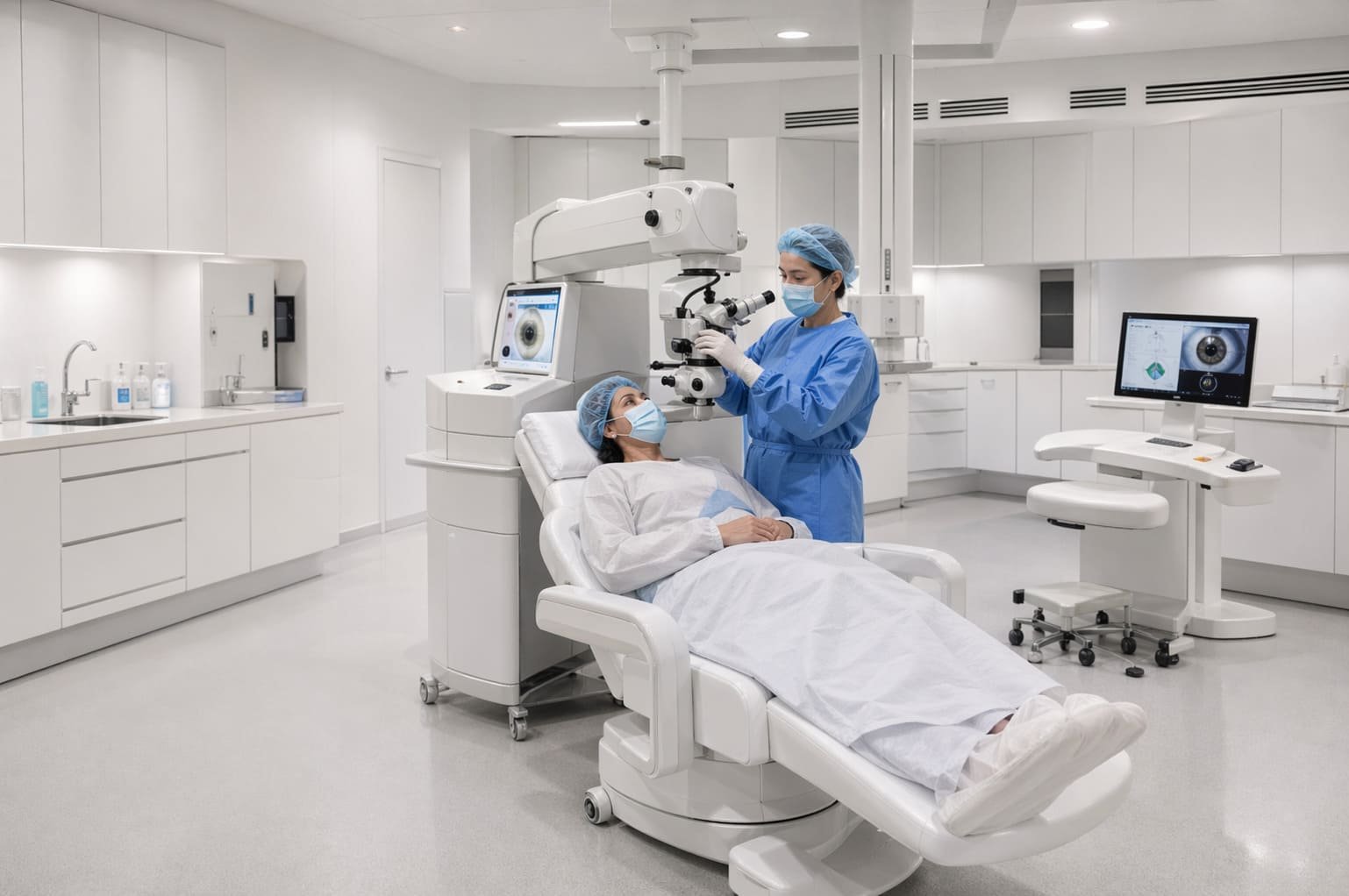
Take time to discuss both your vision goals and lifestyle with your surgeon, as these can affect your options.

What are the main surgical options for correcting strong prescriptions?
Four procedures usually come up in this conversation: LASIK, TransPRK, ICL, and lens replacement. Each solves the problem in a different way.
LASIK, short for Laser-Assisted In Situ Keratomileusis, reshapes the cornea under a thin flap. Recovery is often quick, and many people like the speed of visual improvement. For stronger prescriptions, LASIK can still be suitable if the cornea is thick enough and the treatment depth remains sensible.
TransPRK also reshapes the cornea, but it does so from the surface and does not involve a flap. That makes it useful in some eyes where flap-based treatment is less suitable. Surface treatment can mean a slower early recovery, which some people accept in exchange for a procedure that better matches their corneal anatomy.
ICL, or implantable contact lens surgery, takes a different route. Instead of reshaping the cornea, the surgeon places a lens inside the eye, behind the iris and in front of the natural lens. This can be a strong option for high myopia, especially where laser correction would require too much corneal change. Vision quality in high prescriptions can be very good with this approach, provided the internal measurements of the eye are suitable.
Lens replacement surgery, also known as refractive lens exchange, removes the eye’s natural lens and replaces it with an artificial one. This is the same basic principle used in cataract surgery, although the reason for doing it may be refractive correction rather than a cataract. In over-50s, especially those noticing reading problems or early lens changes, lens replacement can make more sense than corneal laser treatment. Some artificial lenses are monofocal, while others, including multifocal lenses, can reduce dependence on glasses for more than one distance.
At The Vision Surgeon, that choice is made through full assessment rather than preference for one category of treatment. Mr Mukherjee sees patients personally and weighs prescription strength alongside corneal measurements, lens status, pupil size, tear film, and retinal health. Someone asking about LASIK vs ICL may arrive expecting laser and leave with a clearer reason for choosing a lens-based procedure instead.

What practical factors should you weigh when choosing between procedures?
A clinically suitable option is not always the one that fits your life best. Daily routine, age, budget, work demands, and tolerance for recovery all matter.
Someone who needs to return to desk work quickly may look favourably on LASIK because the early recovery is often faster than surface laser treatment. A person with a physically demanding job may focus more on the long-term structure of the procedure and whether a flapless treatment or an internal lens suits their circumstances better. An older patient who is already frustrated by reading glasses often weighs lens replacement differently from a younger patient who mainly wants distance freedom.
Cost sits in the same decision, and it deserves plain speaking. Indicative pricing for laser eye surgery is often around £1,400 to £1,800 per eye for LASIK, with TransPRK in a similar range. ICL is commonly around £3,000 per eye. Lens replacement or private cataract-style lens surgery often falls between £2,000 and £4,000 per eye depending on lens choice. Those figures are guides rather than promises, because your final treatment plan depends on assessment.
Long-term value is often clearer than the upfront number. A high prescription usually means thinner lenses, specialist coatings, regular updates, and contact lens costs that accumulate year after year. That does not make surgery right for everyone, although it does change the comparison.
Consultation and aftercare should also carry weight. You are choosing more than a procedure code. You are choosing how carefully suitability is assessed, who performs the surgery, and how follow-up is handled if healing takes a little longer than expected. In a consultant-led setting, that continuity can feel very different from a model where the assessment and surgery are carried out by different people.
Regulated private care also comes with responsibilities around consent, balanced discussion of risk, and clear records, with standards shaped by bodies such as the GMC and CQC. From a patient’s point of view, that usually translates into something simple: you should leave the consultation knowing why one option suits you better than another, including where the trade-offs sit.

Get answers to your questions about surgery, aftercare and the benefits of consultant-led treatment.
Message UsWhat do people with strong prescriptions wish they’d known before surgery?
Most people who have been through this process wish they had known earlier that a strong prescription is not the main story. The quiet advantage lies in understanding that the best result usually comes from matching the procedure to the eye you have now, not the treatment name you had in mind before the consultation. Experienced patients also tend to appreciate, with hindsight, how much realistic expectations shape satisfaction: sharp distance vision may improve greatly, but age, reading needs, night symptoms, and healing patterns still deserve an honest place in the conversation. Another point often learned later is that local, consultant-led care can matter more than polished marketing. Being assessed and treated by the same ophthalmologist, without being passed along or sent elsewhere for surgery, gives a level of clarity that many people wish they had valued from the start.