

Can both eyes be treated together or separately?
Yes, both eyes can often be treated on the same day, and for many forms of eye surgery that approach is widely used and considered safe when the patient is suitable. In other cases, treating one eye at a time is the better choice, especially if the prescription is complex, the eye health needs closer monitoring, or the procedure itself is usually staged.
That question matters because people tend to focus on the idea of doubling the risk if both eyes are treated together. In practice, the decision is more specific than that. Surgeons look at the type of operation, the condition of each eye, the expected recovery, and whether the benefits of one visit and one recovery period outweigh the reasons to separate treatment. Standards set by bodies such as the Royal College of Ophthalmologists, the GMC, and the CQC place patient safety and informed consent at the centre of that decision.
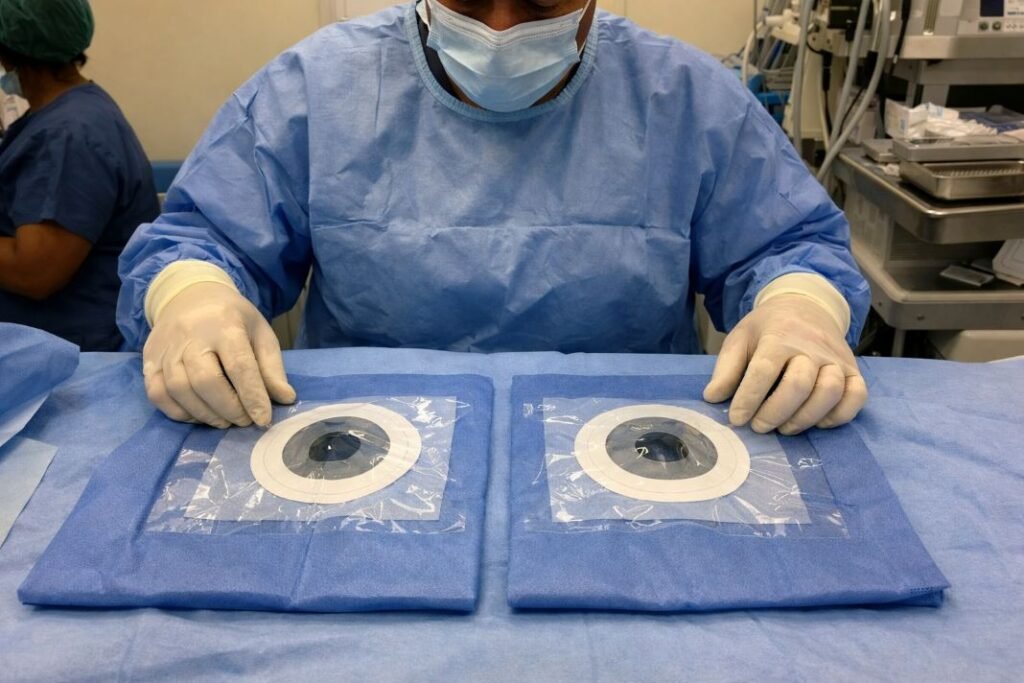
Table of Contents
Who is this decision most relevant for?
Some patients will face this choice directly, while others may find that the usual pathway for their procedure is already established.
You are most likely to think about treating both eyes at once if you are considering laser vision correction, lens replacement surgery, or cataract surgery in both eyes. The decision is especially relevant if both eyes have a similar prescription and similar eye health.
The groups who commonly ask about this include:
- Younger adults considering laser eye surgery, including LASIK or TransPRK, who want one recovery period and a quicker return to daily life.
- Adults over 50 looking at refractive lens exchange, also known as lens replacement surgery, or cataract surgery, where both eyes may need treatment within a fairly short timeframe.
- People with strong prescriptions, marked differences between the eyes, or conditions such as dry eye, glaucoma, or corneal irregularity, where a staged approach may be preferred.
Age on its own does not decide it. A healthy 60-year-old having lens replacement may be a clearer candidate for same-day bilateral surgery than a younger patient with a more complicated cornea. Equally, someone with a very straightforward short-sighted prescription may be well suited to treatment in one session, whereas another person may benefit from spacing the procedures to allow the first eye to settle before planning the second.
At The Vision Surgeon, that judgement is made after a full assessment rather than by using a standard template. Mr Mukherjee’s refractive qualifications, including CertLRS and fellowship training recognised by the World College of Refractive Surgery, matter here because the safest plan is often the one that best fits the individual eye rather than the one that sounds most convenient.
How does the procedure differ when both eyes are treated together?
Treating both eyes in one session usually means one admission, one round of preparation, and one immediate recovery period. Treating one eye at a time means repeating the process on separate dates, with vision adjusting in stages.
For laser eye surgery, the practical difference is usually straightforward. If both eyes are done on the same day, the surgeon treats one eye and then the other in the same sitting, using separate sterile steps for each eye. You go home the same day and recover with both eyes healing together. That can be appealing because there is no period where one eye has been corrected and the other has not.
With staged laser treatment, the first eye is treated and allowed to recover before the second is done later. Some patients like the idea of seeing how the first eye responds. Others find the in-between period awkward, particularly if the untreated eye still needs a contact lens or a strong spectacle correction.
Lens replacement and cataract surgery follow a similar pattern in terms of planning, but the details can feel more significant because the natural lens is being replaced. Same-day bilateral surgery means both eyes are operated on in one visit, with each eye handled as a separate procedure and with strict infection control measures. Staged surgery means the second eye follows after the first eye has settled, often after days or weeks depending on the clinical plan.
Recovery feels different as well. Once both eyes have been treated together, there is usually one main adjustment period. If surgery is staged, depth perception and visual balance can feel uneven between appointments, especially if one eye has already been corrected for distance and the other has not. That mismatch is often the practical issue patients notice most.
In Colchester, whether surgery takes place at Oaks Hospital or assessment is carried out through the Colchester Eye Centre, the day itself tends to be calm and structured. The key difference is less about the room and more about whether your visual recovery happens all at once or in two distinct chapters.

Safety considerations: risks and benefits of each approach
Safety is not measured by a single rule that says one method is always better. The safer option is the one that matches the procedure, the eye health, and the patient’s circumstances.
Same-day bilateral surgery can offer clear benefits. There is one course of pre-operative preparation, fewer hospital visits, and one concentrated period of recovery. Many people also prefer to avoid living for days or weeks with a large difference in vision between the two eyes.
Staged surgery has advantages of its own. The surgeon can review the healing and visual result from the first eye before proceeding with the second. That can be useful if there is any uncertainty about healing behaviour, lens choice, corneal response, or visual adaptation.
A balanced view of the two approaches looks like this:
- Same-day treatment may reduce disruption, simplify scheduling, and allow binocular vision to recover more quickly.
- Separate treatment may offer extra caution in selected cases, particularly where eye health is less straightforward or where the first result may influence the second plan.
- Both approaches still carry the usual surgical risks, including infection, inflammation, dry eye symptoms, glare, halo effects, or a need for further adjustment depending on the procedure.
A common fear is that doing both eyes together means a problem would affect both eyes at once. That possibility is one reason surgeons take bilateral procedures seriously and use strict protocols for sterility, assessment, and selection. Another fear moves in the opposite direction, with some people assuming one-eye-at-a-time surgery must always be safer. That is too simple. For certain patients, the strain of uneven vision after staged treatment can be a genuine drawback, especially if driving, reading, or screen work are already difficult.
Clinical standards matter more than a blanket preference. The Royal College of Ophthalmologists, the GMC, and the CQC all support careful consent, appropriate patient selection, and clear risk discussion. That means the decision should be reasoned, documented, and specific to the person in front of the surgeon.

Suitability and personalisation: how decisions are made
A good recommendation starts well before the day of surgery. The choice between treating both eyes together and treating one eye at a time comes from the pre-operative assessment, your medical history, and a realistic conversation about how you live.
Several factors shape that recommendation:
- The type of procedure, including LASIK, TransPRK, lens replacement, or cataract surgery.
- The health of the cornea, lens, retina, and ocular surface.
- The size and stability of the prescription in each eye.
- Any history of dry eye, glaucoma, previous eye surgery, or other eye disease.
- Your work, driving needs, home support, and comfort with either one recovery period or two.
Lifestyle often influences the final decision more than patients expect. A person who relies on balanced vision for work may struggle with staged treatment because of the temporary mismatch between the eyes. Someone who feels anxious about both eyes being operated on in one session may be more comfortable separating the procedures, even if both options are clinically reasonable.
At The Vision Surgeon, patients are seen by Mr Mukherjee personally, which means the same consultant who advises on timing also understands the finer detail of the surgery itself. That continuity matters because it reduces the gap between assessment and operative planning. A surgeon may favour staging if one eye has a denser cataract, if the measurements raise a question about lens power, or if there is a surface issue that should settle first. In a straightforward case with healthy eyes and matching findings, same-day bilateral surgery may make complete sense.
The best plan is usually the one that balances clinical judgement with patient preference, without pretending that convenience and safety are separate conversations.
Cost implications and value considerations
Cost can differ slightly depending on whether surgery is done in one sitting or across separate dates, although the larger issue is usually overall value rather than a simple one-eye-versus-two-eyes calculation.
For private treatment, indicative pricing often follows the procedure itself. LASIK is commonly in the region of £1,400 to £1,800 per eye. TransPRK is generally in a similar range. Cataract surgery and lens replacement surgery often fall between £2,000 and £4,000 per eye, depending on lens choice. ICL, or implantable contact lens surgery, is commonly around £3,000 per eye. Final costs depend on the individual assessment and the treatment plan.
When both eyes are treated together, patients may feel they are getting better practical value because there is one main recovery period, fewer trips to clinic, and less time away from work or driving. A staged pathway may involve more appointments and a longer overall process, even if that remains the better medical choice.
Price alone is not a reliable way to judge suitability. Lens type, challenge, aftercare, surgeon involvement, and whether you are seen by the same consultant throughout all affect the experience as much as the fee itself. NHS care also sits in a different category, particularly for cataract treatment, because the pathway, waiting times, and lens choices are not the same as private care.
A careful comparison therefore looks beyond the invoice and includes how treatment fits into your daily life, your visual goals, and the degree of continuity you want from assessment through aftercare.
Local expertise and consultant-led care in Colchester
For many patients, the question is not just whether both eyes can be done together. The question is who is making that call and whether the same person will still be involved on the day of surgery.
That is where consultant-led care has real value. Mr Mukherjee assesses patients personally, advises on whether simultaneous or staged surgery is appropriate, and performs the procedure himself. You are not passed from one clinician to another or asked to travel elsewhere for the operation.
Receiving care locally also changes the practical experience. Colchester is easier to reach for many patients across Essex and Suffolk than a London clinic, and local follow-up can feel less disruptive when several visits are needed. If both eyes are treated together, nearby aftercare is especially reassuring in the first few days. If surgery is staged, having the same local consultant review the first result before the second eye is planned adds an extra layer of continuity.
His NHS consultant background and additional fellowship training are relevant here because bilateral surgery decisions depend on judgement, not routine. A surgeon with broad experience across laser vision correction, cataract surgery, lens replacement, corneal disease, and glaucoma is better placed to recognise when convenience is appropriate and when caution deserves more weight. Patients often notice that difference in the quality of the discussion long before they notice it in the operating theatre.

Looking ahead: what patients often wish they knew before deciding
Many people assume the hard part is choosing between both eyes at once and one eye at a time. In reality, the harder part is often understanding why one option suits them better.
Patients often wish they had known three things earlier:
- Convenience matters, but visual balance during recovery matters too.
- Same-day surgery is not automatically risky, and staged surgery is not automatically safer.
- Feeling comfortable with the plan is part of good consent, not an afterthought.
Another common misconception is that a quick answer should exist for everyone. Eye surgery does not work like that. The right plan depends on the procedure, the health of the eyes, and how much value you place on one recovery period compared with the chance to assess the first eye before the second is treated.
A well-informed decision usually feels calmer than patients expect. Once the reasons are explained clearly, most people stop thinking in terms of a blanket rule and start thinking in terms of what is sensible for their own eyes. That shift in perspective often makes the whole process easier to approach, whether surgery happens in one sitting or over two carefully chosen dates.