Is laser eye surgery permanent, and if so, what can still change later?
Laser eye surgery permanently reshapes the cornea, so the treated prescription does not simply wear off. Your eyes can still change over time because of natural ageing, including reading vision changes and later cataract development. In plain terms, the surgical effect lasts, but your eyesight may still alter for reasons the treatment was never meant to stop.
For most people, that means laser vision correction gives long-lasting improvement in distance vision, but it does not promise identical eyesight for life. Guidance from bodies such as the Royal College of Ophthalmologists, the General Medical Council, ASA/CAP and the NHS supports clear, balanced expectations.

Table of Contents
The Short Answer: How Long Does Laser Eye Surgery Last?
LASIK and TransPRK aim to correct refractive error by changing the shape of the cornea. That physical change is permanent. What sometimes causes confusion is that the rest of the eye continues to age in the usual way.
A simple way to think about it is this:
- The laser treatment itself is permanent.
- The prescription treated at the time is usually stable if your eyes were suitable beforehand.
- Future vision changes can still happen because eyes are living tissue, not fixed camera lenses.
Many people enjoy clear vision for years after treatment. Some will later notice changes linked to age, hormonal shifts, cataracts, or a prescription that was never fully stable before surgery.
Who Benefits Most from Laser Eye Surgery and When Might Vision Change Again?
Results often remain most stable in adults whose prescription has already settled. A person in their late 20s or 30s with mild to moderate short-sightedness and little recent change in glasses strength may keep good distance vision for a long time after treatment.
By contrast, someone whose prescription is still moving year by year may be more likely to notice change later. Stability before surgery matters because the laser corrects the vision you have at that point, not the vision your eyes might develop in future.
Age also affects what kind of change you may notice. Around the 40s and 50s, many people develop presbyopia, which is the normal loss of near focusing ability. Laser eye surgery does not stop that process. A person who had excellent distance vision after LASIK at 32 may still need reading glasses at 47.
Older adults need a different conversation. If you are over 50 and already seeing age-related reading changes, lens-based procedures can sometimes be a better fit than corneal laser treatment. At The Vision Surgeon, Mr Mukherjee assesses suitability with that wider view in mind, which means that the right procedure depends on the eye you have now and the changes likely to come next.
Enhancement treatment can occasionally be considered later if there is residual prescription or a meaningful shift over time. That is usually a case-by-case decision, not a routine part of surgery.

How Laser Eye Surgery Alters Vision and What It Cannot Prevent
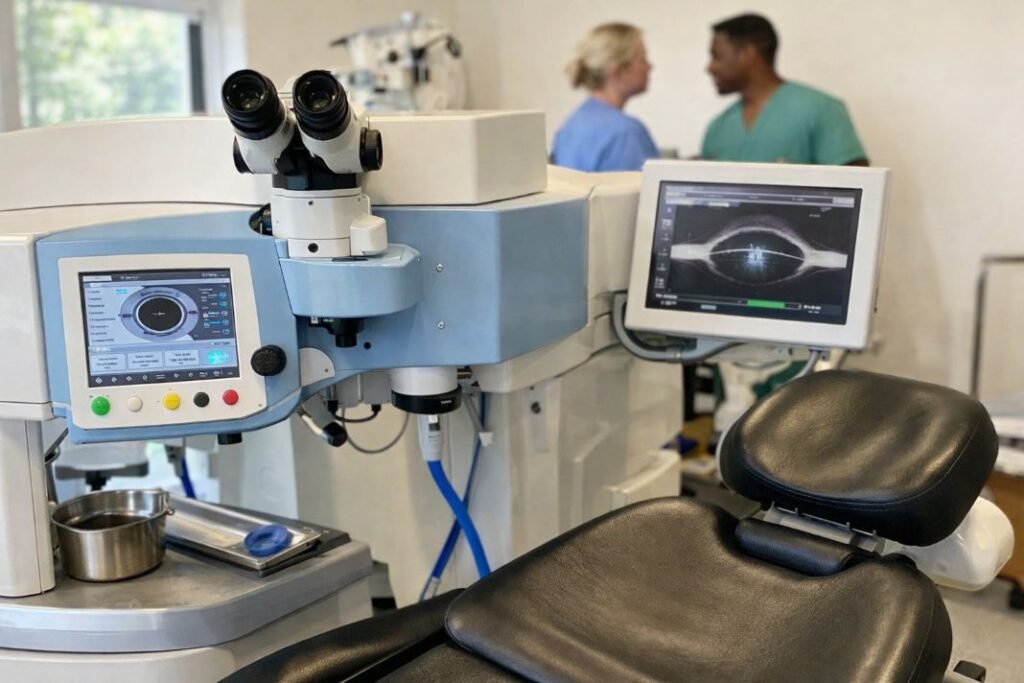
Laser eye surgery works by reshaping the cornea, which is the clear front window of the eye. In LASIK, a thin flap is created before the laser reshapes the tissue underneath. In TransPRK, the laser treats the surface without making a flap. Both methods aim to correct refractive error so that light focuses more accurately on the retina.
An easy analogy is adjusting the front element of a camera lens. The treatment changes how light enters the eye, but it does not replace every part of the optical system.
What laser eye surgery can do:
- Correct short-sightedness, long-sightedness and some astigmatism
- Reduce dependence on glasses or contact lenses
- Permanently alter the corneal shape that caused the original focusing problem
What laser eye surgery cannot do:
- Prevent presbyopia from developing with age
- Stop cataracts forming later in life
- Freeze the eye in its current state forever
- Suit every prescription or every cornea
That distinction matters. The procedure changes the cornea, but it does not stop the natural lens inside the eye from ageing, becoming less flexible, or eventually turning cloudy.
What to Expect After Surgery: Stability, Enhancements, and Natural Changes
Vision often improves quickly after laser eye surgery, although exact recovery depends on the procedure. LASIK commonly settles faster in the early days, while TransPRK may take longer to sharpen because the surface layer needs to heal first.
Once the initial recovery has passed, eyesight usually reaches a stable point over the following weeks or months. Aftercare appointments track that progress and check healing, comfort and visual quality. Good follow-up is part of the treatment, not an optional extra.
Longer term, the pattern is usually straightforward. The corrected prescription stays in place, then later changes, if they happen, tend to come from the normal ageing of the eye. Reading vision changes are a common example. Cataracts are another, particularly in later life.
Enhancements are sometimes discussed if:
- A small prescription remains after healing.
- Vision shifts enough over time to become bothersome.
- The eye remains suitable for further corneal treatment.
That does not mean everyone should expect a second procedure. Plenty of patients never need one. In other cases, a later change may be better addressed with glasses for certain tasks, or with lens surgery if cataract or age-related lens changes become the main issue.
At The Vision Surgeon, aftercare is led by Mr Mukherjee, so patients are reviewed by the same consultant who planned and performed the procedure. That continuity can be reassuring if your vision changes years down the line and you want advice rooted in your original treatment history.
Risks, Limitations, and Setting Realistic Expectations
Laser eye surgery has a long track record, but it still needs careful assessment and honest consent. Rules set by ASA/CAP, the GMC, CQC and the Royal College of Ophthalmologists all point in the same direction: patients should understand both the likely benefits and the possible downsides.
Possible risks and limitations include:
- Dry eye symptoms, which may be temporary or longer lasting in some cases
- Glare, haloes or visual disturbance, especially in low light
- Undercorrection or overcorrection
- Residual need for glasses for some activities
- Slower healing or fluctuation in vision during recovery
- Rare complications affecting the cornea or flap in LASIK
Outcome differences happen because eyes differ. Corneal thickness, pupil size, tear film quality, prescription strength and age can all influence the result and the recovery experience. A thorough pre-operative assessment is therefore central to deciding whether treatment is suitable and which method is most appropriate.
No responsible surgeon should suggest that laser eye surgery guarantees perfect eyesight forever. A better expectation is that many suitable patients gain lasting freedom from glasses for much of daily life, with the understanding that ageing can still bring fresh visual needs. Reading glasses at 50 do not mean surgery failed at 30.
Cost Considerations: Value Over Time and What Affects Pricing
Cost matters because laser eye surgery is an elective treatment, and people want to weigh the upfront spend against the years of visual benefit that may follow. In Essex and Suffolk, pricing can vary by clinic, technology, surgeon involvement and the challenge of the prescription.
Indicative private pricing is often in the following range:
- LASIK: about £1,400 to £1,800 per eye
- TransPRK: usually in a similar range to LASIK, subject to assessment
Several factors affect the final figure. A higher prescription or more detailed treatment planning can influence price. Surgeon-led care, in which your consultation, surgery and follow-up are all handled by the same consultant, may also shape cost because it changes the structure of care, not just the day of treatment.
Value over time is worth considering alongside the headline number. Glasses, prescription sunglasses, contact lenses, solutions and regular replacements all add up over the years. For someone who has worn lenses daily since university, the long-term spend can be substantial, even before convenience and lifestyle are taken into account.
The decision still has to make sense for your budget today. A sensible comparison looks at both the financial side and the personal one, including sport, travel, work comfort and freedom from contact lens maintenance.

Local Expertise in Colchester: Why Surgeon-Led Care Matters for Long-Term Results
Long-term satisfaction with laser eye surgery does not depend on the laser alone. Assessment quality, procedure choice and follow-up care all shape the experience before and after treatment.
In a consultant-led setting, the same surgeon evaluates suitability, explains limitations, performs the procedure and reviews recovery. That continuity can be especially valuable if your eyes do not fit a standard pattern, or if you return years later with a new question about presbyopia, cataracts or enhancement options.
Some providers use a chain model where assessment and surgery may involve different clinicians, or where the procedure itself takes place away from the consultation site. A local surgeon-led practice offers a different experience. Patients in Colchester, Essex and Suffolk can be assessed and treated without the need to travel to London, and they can speak to the same consultant who knows their case from the outset.
Mr Mukherjee brings a depth of expertise that sits comfortably within that model. He is a triple fellowship-trained consultant ophthalmologist with CertLRS recognition from the Royal College of Ophthalmologists, and he also leads an NHS ophthalmology unit. For patients, that tends to matter most in the details: careful selection, clear advice if laser is not the best option, and follow-up grounded in personal knowledge of the eye in front of him.
Looking Ahead: How to Think About Vision Correction and Ageing Eyes
Eyes change because people age. That remains true whether you wear glasses, have LASIK, choose TransPRK or never have surgery at all. The useful question is less about whether time stops and more about which visual problem you are solving now, and which changes may still arrive later.
Seen in that light, laser eye surgery is one part of lifelong eye health. It can permanently correct a prescription that is bothering you today, yet regular eye checks still matter in future for pressure, retinal health, lens clarity and ordinary age-related change.
A sensible approach is to keep three points in mind:
- Judge surgery by what it is meant to correct, not by conditions it cannot prevent.
- Expect your visual needs to shift across different decades of life.
- Treat routine eye examinations as ongoing care, even if your sight feels excellent.
Vision correction has advanced steadily, and treatment choices continue to widen for people at different ages and prescription ranges. That is good news, because the story of your eyesight does not end with one procedure. It simply enters a new, and often much clearer, chapter.