
How long does it usually take to recover from LASIK?
Most people notice a big improvement in vision within 24 hours of LASIK, return to many normal activities within a few days, and reach a more settled stage of healing over the following weeks. Functional vision often comes back quickly, but full recovery, including surface healing, dryness settling, and vision stabilisation, usually takes longer than a single day.
Recovery happens in stages, and that distinction matters. You may be able to work, drive, and read fairly soon after treatment, but your eyes are still healing in the background and still need careful aftercare.

Table of Contents
The Short Answer: Typical LASIK Recovery Timelines
A straightforward answer is this: LASIK downtime is usually short, but LASIK healing time is not the same as instant perfection. Many patients feel comfortable enough to resume desk-based work within one to three days, though exact timing depends on vision quality, comfort, and the advice given after surgery.
- First 24 hours: watery eyes, stinging, light sensitivity, and blurred or misty vision are common. Many people are advised to rest with their eyes closed for several hours after treatment.
- First week: vision often becomes clearer, although fluctuation, halos, glare, and dryness may still come and go. Normal routines often restart during this period, with some limits on rubbing the eyes, swimming, and eye makeup.
- First month: vision usually feels more stable, but fine adjustments in clarity can still happen. Follow-up care remains important during this stage.
Functional vision means seeing well enough for daily life. Full recovery refers to the wider healing process, including comfort, tear film recovery, and more consistent focus. Guidance from the Royal College of Ophthalmologists, NHS patient information, and GMC-aligned consent standards all support the same broad principle: early improvement is common, but variation between individuals is normal.
Who Is LASIK Recovery Most Relevant For?
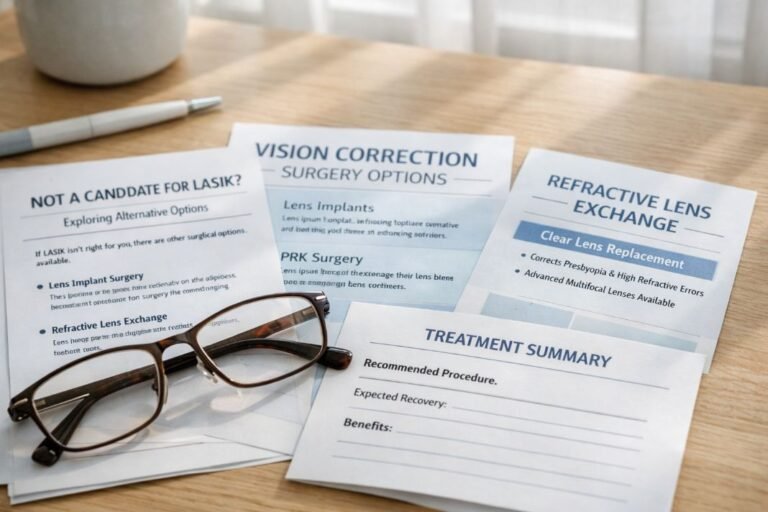
LASIK recovery information is most useful for adults with a stable prescription, suitable corneal thickness, and healthy eyes apart from short sight, long sight, or astigmatism. Anyone thinking about laser eye surgery recovery should also know that LASIK is only one option, and the quickest route is not always the best clinical choice.
Some people are typical LASIK candidates, whereas others may be better suited to a different procedure.
More likely to suit LASIK | May need an alternative
|
|---|---|
Stable glasses or contact lens prescription | Changing prescription |
Healthy cornea with enough thickness | Thin or irregular cornea |
Mild to moderate dry eye risk | Significant dry eye symptoms |
Usually younger adults and some people in midlife | Over-50s with lens changes or early cataract |
Prescription within suitable treatment range | Very high prescription that may suit ICL better |
For patients whose cornea is less suitable for a flap-based procedure, TransPRK, a surface laser treatment, may be discussed instead. For people over 50, especially if reading glasses are already part of daily life or early cataract changes are present, refractive lens exchange, also called lens replacement surgery, can be a better fit. Higher prescriptions may point the discussion toward ICL, which stands for implantable contact lens.
At The Vision Surgeon, suitability is assessed on the basis of prescription stability, corneal measurements, dry eye risk, and overall eye health. Mr Mukherjee holds CertLRS from the Royal College of Ophthalmologists and is a Fellow of the World College of Refractive Surgery, which means that procedure choice is led by clinical fit rather than a one-size-fits-all pathway.

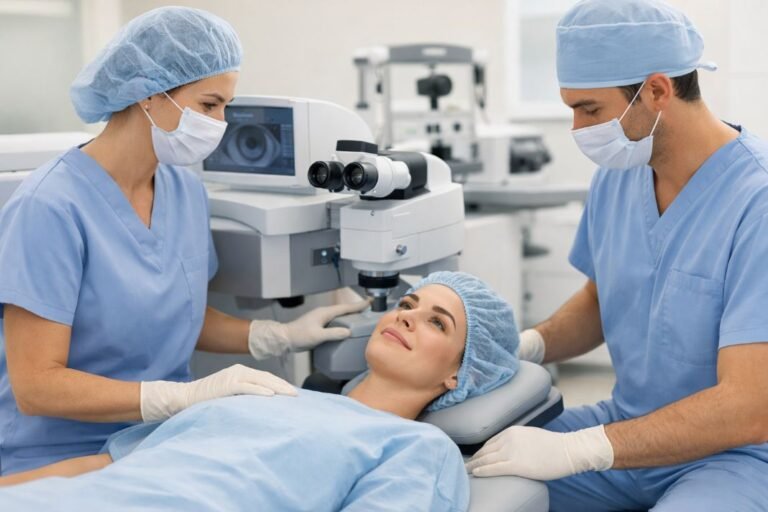
What Happens During LASIK and Why It Affects Recovery
LASIK, short for Laser-Assisted In Situ Keratomileusis, reshapes the cornea so that light focuses more accurately on the retina. Recovery is usually quicker than with surface laser procedures because the outermost surface of the cornea is disturbed less.
The procedure itself is brief, but several steps influence how the eye heals.
- A femtosecond laser creates a very thin corneal flap.
- That flap is gently lifted to expose the corneal tissue underneath.
- A second laser reshapes the cornea according to your prescription.
- The flap is placed back into position, where it adheres naturally without stitches.
Because the surface layer remains more intact than it does in TransPRK, discomfort is often shorter-lived and vision clarity can return sooner. Patients still commonly notice tearing, a gritty sensation, variable sharpness, and sensitivity to bright light in the first hours after surgery. Those symptoms usually reflect the eye’s normal protective response and the early stages of healing, not a sign that anything has gone wrong.
A useful way to think about it is this: LASIK changes the optics quickly, but the tear film and corneal surface still need time to settle. That is why someone may read a phone screen the next day and still have intermittent dryness by evening.

The LASIK Recovery Process: Day by Day and Week by Week
Most people find that the first few hours are the most uncomfortable part. Rest, lubricating drops, and following aftercare instructions closely make a real difference during that early period.
First few hours
Straight after treatment, the eyes may water and feel sore, gritty, or as if an eyelash is trapped inside. Vision is often hazy at first. Protective eye shields are commonly used for the first night to reduce the chance of rubbing during sleep.
Day 1 to Day 2
By the next day, many patients already see much better than they did without glasses or contact lenses before surgery. Even so, glare, halos around lights, and patchy sharpness can still happen, particularly in dim settings or late in the day.
Driving may be possible once vision meets the legal standard and the surgeon confirms it is safe. Desk work is often manageable within a day or two, although long hours on a screen may make dryness more noticeable.
First week
During the opening week, laser eye surgery recovery usually feels less dramatic and more practical. Eye drops continue at set intervals. Swimming, hot tubs, contact sports, dusty settings, and eye makeup are commonly avoided for a period advised by the clinic.
Exercise often returns in stages. Gentle walking may be fine quickly, but anything that risks sweat, impact, or rubbing around the eyes is usually postponed. Follow-up appointments during this phase check that the flap is well positioned and that healing is progressing as expected.
First month
Over the next few weeks, vision after LASIK often becomes more dependable. Small fluctuations can still appear, especially on waking, after prolonged screen use, or in dry air. Night-time symptoms such as halos and glare may improve gradually rather than all at once.
If discomfort is worsening, redness is marked, or vision drops instead of improving, prompt review is needed. A routine healing course tends to move unevenly, but it should still move in the right direction.
Factors That Can Affect Your LASIK Recovery Time
No two eyes heal in exactly the same way. Slow LASIK recovery does not always mean a complication, and quick visual improvement does not mean aftercare can be ignored.
Several factors influence LASIK healing factors and day-to-day comfort:
- Age and natural tear production, which can affect dryness after surgery
- Strength and type of prescription, including astigmatism
- Corneal thickness and shape
- Existing dry eye, blepharitis, or other surface problems
- How closely eye drop schedules and other aftercare protocols are followed
- Environmental irritants such as air conditioning, smoke, wind, and heavy screen use
- Medication use and general health factors that may influence healing
A younger patient with a stable moderate prescription and healthy tear film may recover very quickly. By contrast, someone with pre-existing dryness who spends ten hours a day in front of multiple monitors may need longer before vision feels consistently comfortable.
NHS advice on eye surgery recovery often highlights practical habits for the same reason. Hydration, lubrication, sensible screen breaks, and keeping hands away from the eyes can shape the experience just as much as the procedure itself.
Risks, Complications, and When to Seek Advice
A balanced view matters here. LASIK is widely performed and many patients recover smoothly, but all surgery carries risk, and no surgeon should present recovery as completely predictable.
Common, milder symptoms during recovery can include:
- Dryness
- Light sensitivity
- Glare or halos
- Mild discomfort or grittiness
- Temporary fluctuation in sharpness
Warning signs that need prompt clinical advice include:
- Increasing pain
- Marked redness
- Sudden worsening of vision
- Discharge from the eye
- Persistent symptoms that feel clearly worse rather than gradually better
Rare problems can include infection, inflammation, flap-related issues, or visual disturbances that last longer than expected. Follow-up appointments exist to monitor for these issues and to support recovery at each stage. ASA/CAP, CQC, GMC, and Royal College of Ophthalmologists standards all point toward the same approach: benefits should be discussed honestly alongside limits and potential complications.
Consultant-led aftercare also has practical value. If the same surgeon assessed your suitability, carried out the procedure, and reviews your healing afterwards, decisions can be made with a fuller picture of your eye health and treatment plan.

LASIK Recovery in Essex: What Sets Consultant-Led Care Apart
Imagine noticing more glare than expected on the second evening after surgery. In that moment, reassurance matters, but so does continuity. Seeing the same surgeon who knows your corneal measurements, prescription, and operative details can make recovery feel far less impersonal.
In Colchester, local aftercare changes the experience in simple ways that patients often value more than they expected. You are not travelling to London for the procedure and then trying to piece together support afterwards. You are also not being assessed by one person and operated on by another on the day.
Mr Mukherjee is an NHS consultant as well as a private refractive surgeon, and every patient pathway is personally led by him. At Oaks Hospital and Colchester Eye Centre, that continuity supports personalised aftercare, follow-up care close to home, and easier review if something needs checking. For patients across Essex and Suffolk, convenience is part of the medical experience, especially in the first week when comfort and practical access matter most.
Beyond the Timeline: What Most People Get Wrong About LASIK Recovery
One of the most persistent LASIK recovery myths is the idea that recovery ends when vision first looks good. In reality, the early improvement can be impressive, but the eyes still need time to settle, adapt, and maintain a stable tear film.
Another misconception is that any fluctuation means the treatment has failed. Vision after LASIK can vary during the healing process, particularly in dry conditions, after long periods of reading, or at night. That kind of variation can be part of normal recovery, provided the overall trend is steady and follow-up findings are reassuring.
Patience plays a bigger role than many people expect. The result you notice on day one is rarely the whole story, and the final stage of vision stability may arrive more gradually than people imagine from advertising or anecdote.
A sensible expectation is better than an exaggerated one. If you judge recovery by how safely you can function, how comfortable your eyes feel, and how steadily your vision settles over the following weeks, the picture becomes much clearer.