
What is the difference between lens replacement surgery and laser eye surgery?
Lens replacement surgery and laser eye surgery both correct refractive error, but they do it in different parts of the eye. Laser treatment reshapes the cornea, which is the clear front surface of the eye, whereas lens replacement removes the eye’s natural lens and replaces it with an artificial lens. In general, laser eye surgery is more often considered by younger adults with stable prescriptions, while lens replacement is often more suitable from the late 40s or 50s onwards, especially if reading vision is becoming a problem or early cataract change is present.

Table of Contents
Understanding the Difference: Lens Replacement Surgery and Laser Eye Surgery
Many people use the phrase “laser eye surgery” to mean any vision correction procedure. In practice, that covers a few different treatments, and lens replacement sits in a separate category.
A simple way to picture it is this. Laser eye surgery adjusts the window at the front of the eye. Lens replacement changes the lens inside the eye. Both approaches aim to sharpen vision, but they solve the problem in different ways.
Laser eye surgery usually refers to procedures such as LASIK, which stands for Laser-Assisted In Situ Keratomileusis, and TransPRK, a surface laser treatment that does not involve creating a flap in the cornea. These procedures reshape the cornea so that light focuses more accurately on the retina. They are commonly used for short sight, long sight, and astigmatism.
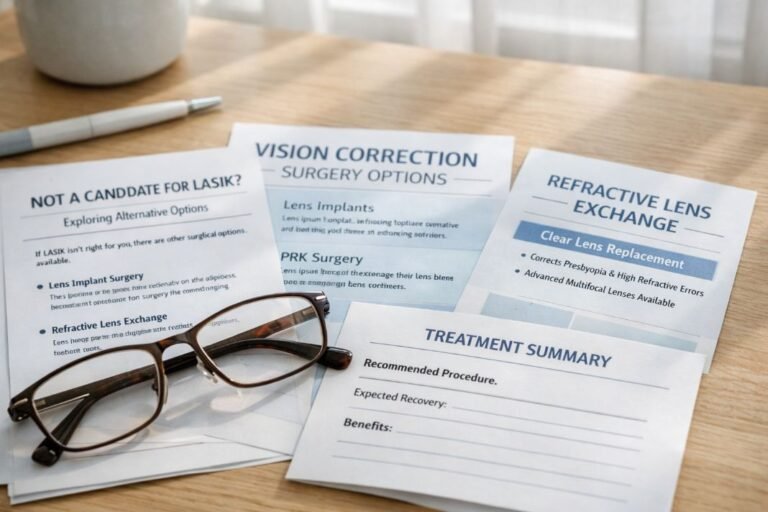
Refractive lens exchange, also known as lens replacement surgery, removes the natural lens and replaces it with an artificial lens. That artificial lens can be chosen to correct distance vision, and in some cases near vision as well through a multifocal lens. The operation is closely related to cataract surgery, except it is done for vision correction before a cataract becomes the main problem.
The terms can be confusing because people may also hear phrases such as RLE, lens exchange, laser lens replacement, or types of eye surgery. The key distinction remains straightforward: cornea reshaping for laser treatment, lens removal and replacement for RLE.
For quick comparison:
- Laser eye surgery treats the cornea and leaves the natural lens in place.
- Lens replacement surgery treats the natural lens by replacing it with an artificial lens.
- Laser treatment is often considered by adults in their 20s, 30s, and 40s with stable prescriptions.
- Lens replacement is often considered by people over 50, particularly if presbyopia or cataract change is affecting day-to-day life.
Clinical assessment and treatment planning should follow accepted standards such as those expected by the Royal College of Ophthalmologists, GMC, and CQC. In specialist refractive practice, qualifications such as CertLRS and fellowship training through bodies including the World College of Refractive Surgery may also matter because they reflect focused experience in vision correction.
Who Is Each Procedure Suitable For?
Suitability usually starts with one practical question: what part of your eye is causing the problem that bothers you most?
Someone in their early 30s with stable short sight and healthy corneas may be a good candidate for laser eye surgery. A person in their mid-50s who is tired of needing reading glasses, distance glasses, and brighter light for close work may be better suited to lens replacement.
A few broad patterns can help you place yourself:
- Laser eye surgery may suit adults with a stable prescription, healthy corneas, and refractive error such as myopia, hyperopia, or astigmatism.
- Lens replacement may suit people with presbyopia, early cataract change, or prescriptions that are less suitable for corneal laser treatment.
- Either option may be ruled out or altered by eye health factors such as thin corneas, dry eye, unstable prescription, glaucoma, retinal problems, or other medical findings.
Age matters, although it is not the only factor. Laser eye surgery is often most suitable before age-related lens changes become a larger issue. Once the natural lens begins to lose flexibility, which causes presbyopia, laser treatment may still be possible in some cases, but it may not address the full picture as effectively as lens replacement.
Prescription strength also plays a part. Very high prescriptions can sometimes push laser treatment outside the safest or most predictable range for the cornea. In those situations, lens-based surgery may be considered instead. Corneal thickness matters for similar reasons, because laser treatment removes tissue and the remaining cornea must still be healthy and stable.
Plenty of people assume they are too old for laser or too young for lens replacement. Real life is less tidy than that. Some patients in their 40s remain well suited to laser treatment, while others in that same decade are already better candidates for lens replacement because of early lens changes, reading dependence, or the nature of their prescription.
An NHS eye examination or optician referral can raise the first flag, but a refractive consultation is the stage where individual suitability becomes clearer. Guidance from the Royal College of Ophthalmologists and standards expected by the GMC support that careful, case-by-case approach.

How Each Procedure Works: Step-by-Step
Both procedures begin in the same place: a detailed assessment of your eyes, your prescription, and your visual goals. That assessment usually looks at corneal shape, corneal thickness, pupil size, lens clarity, tear film, and the health of the retina.
Laser eye surgery
- Before treatment, the surgeon checks that the prescription is stable and that the cornea is suitable for LASIK or TransPRK.
- On the day, anaesthetic drops numb the eye. In LASIK, a thin flap is created in the cornea, often with a femtosecond laser. The laser then reshapes the underlying corneal tissue, and the flap is placed back into position. In TransPRK, the surface layer is treated without making a flap.
- After treatment, vision may improve quickly with LASIK, often within days, while TransPRK generally has a slower recovery because the surface of the cornea needs time to heal.
The experience is usually short, and patients remain awake throughout. Mild discomfort, watering, or light sensitivity can happen in the early recovery period, especially after surface treatments.
Lens replacement surgery
- Before surgery, measurements are taken to choose the most suitable artificial lens. This stage is especially important because the lens selection influences whether the goal is mainly distance vision, reduced need for reading glasses, or a balance between the two.
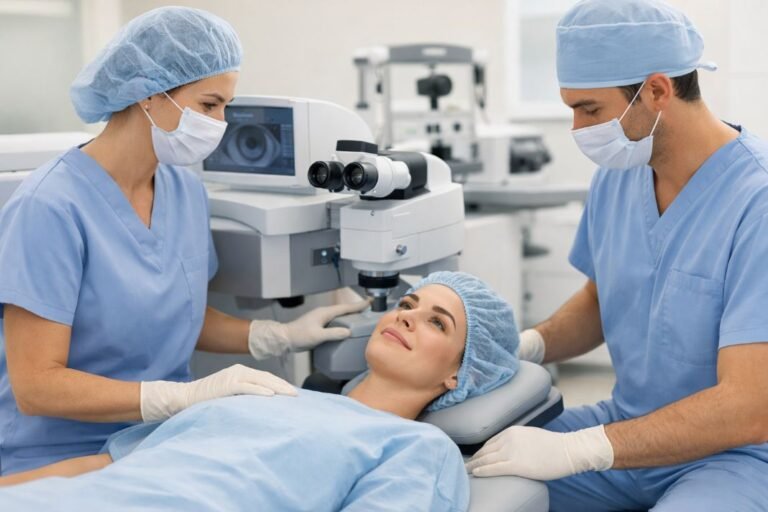
- On the day, anaesthetic drops are used and a tiny incision is made in the eye. The natural lens is gently removed, then an artificial lens is inserted in its place.
- After surgery, the eye begins to settle over days to weeks. Many people notice useful visual improvement quite soon, although fine tuning can continue as the eye heals.
Recovery after lens replacement is different from laser recovery because the surgery takes place inside the eye rather than on the corneal surface. Follow-up appointments and prescribed drops are a routine part of aftercare.
At The Vision Surgeon, patients are seen and treated by Mr Mukherjee personally, which means that the consultation findings, lens choice, and surgical plan remain in the same hands from start to finish. That continuity can be especially helpful when deciding between procedures that may both appear reasonable on paper.

Risks, Benefits, and Realistic Expectations
Both procedures can reduce dependence on glasses or contact lenses. Neither should be viewed as a promise of perfect vision in every situation.
Laser eye surgery may offer quick visual recovery, particularly with LASIK, and it preserves the natural lens. Lens replacement can address age-related lens change and removes the future possibility of cataract in the treated eye because the natural lens has already been replaced.
Potential drawbacks deserve equal attention. Laser eye surgery can be associated with dry eye symptoms, glare, halos, fluctuating vision during healing, and the possibility that some residual prescription remains. Lens replacement carries different considerations, including glare, halos, the need for reading glasses in some cases depending on lens choice, and the usual risks that come with intraocular surgery.
A balanced comparison looks like this:
- Laser eye surgery: preserves the natural lens, often suits younger patients, and can offer a fast return to routine. Possible side effects include dry eye, glare, and the chance that future age-related lens changes will still occur.
- Lens replacement surgery: can correct refractive error and deal with presbyopia or early cataract change at the same time. Possible side effects include visual disturbances such as halos, and some patients may still need glasses for certain tasks depending on the lens selected.
Expectations matter as much as the operation itself. A patient who wants to read tiny print in dim light without glasses after lens replacement may be disappointed if that goal was never realistic for their chosen lens. A patient hoping laser treatment will stop all future age-related vision change may feel similarly let down.
Regulatory guidance from bodies such as the GMC and ASA/CAP supports clear, balanced communication about risks and outcomes. In plain terms, that means discussing what treatment may improve, what it may not improve, and what side effects or trade-offs can occur. Honest conversations about night driving, screen work, reading habits, and tolerance for visual compromise often matter more than glossy procedure labels.
Cost Considerations and Value
Private eye surgery is a significant decision financially as well as medically. Typical prices vary by procedure, technology, lens choice, and the challenge of your prescription.
In broad terms, LASIK often falls around £1,400 to £1,800 per eye. TransPRK is usually in a similar range. Lens replacement surgery and cataract-style refractive lens procedures often range from about £2,000 to £4,000 per eye, mainly because lens type can change the price substantially. Implantable contact lens surgery sits in a different category again and is often priced separately.
The headline figure never tells the whole story. A standard monofocal artificial lens will usually cost less than a premium or multifocal lens. Surgeon expertise, aftercare arrangements, and whether the same consultant manages the full pathway also contribute to value.
Long-term spending can shift the picture. Glasses, prescription sunglasses, contact lenses, solutions, eye tests, and replacement frames all add up over time. That does not mean surgery is automatically the better financial choice, but it does mean a like-for-like comparison needs more than the upfront procedure fee.
Some people focus on laser eye surgery price because it appears lower than the cost of lens replacement. That comparison can be misleading if the person is already developing presbyopia or cataract change, since laser treatment may not address the issue that matters most over the next several years. A cheaper procedure is not better value if it solves only part of the problem.
Standards expected by the CQC and Royal College of Ophthalmologists place the emphasis on safe, appropriate treatment rather than simple price competition. Seen that way, value comes from suitability, clarity of advice, continuity of care, and a result that matches the patient’s real needs.
Local Expertise and Personalised Care: Why Surgeon-Led Matters
Eye surgery can feel very different depending on who assesses you, who advises you, and who actually performs the operation.
One model involves several handovers. Another keeps the whole process with the same consultant. For many patients, especially those choosing between two possible procedures, that continuity is reassuring because the person who weighs the pros and cons is also the person carrying out the surgery.
Mr Mukherjee is a consultant ophthalmologist based in Colchester with NHS leadership experience and specialist refractive credentials, including CertLRS and fellowship training. In practical terms, that means patients are discussing LASIK, TransPRK, and lens replacement with a surgeon whose work spans routine vision correction as well as more complex eye conditions.
Location matters too. Access to surgery in Colchester can spare patients from travelling to London for treatment and aftercare. That may sound like a small detail at first, yet it becomes much more relevant when you are arranging lifts, attending follow-up visits, or simply trying to recover comfortably close to home.
Consultant-led care also tends to sharpen decision-making. If your corneas are borderline for laser treatment, or your age and symptoms point more strongly toward lens replacement, a nuanced recommendation matters more than a one-procedure pathway. The difference can be as simple as being told, with good reasons, that the option you first asked about is not the one that best fits your eyes.

Making the Right Choice: Key Considerations and Common Misconceptions
The best choice is usually the one that matches your eyes now and your likely vision needs over the next decade, not the one with the most familiar name.
A few misconceptions are worth clearing up. Laser eye surgery is not automatically the best option for everyone who wants freedom from glasses. Lens replacement is for people with advanced cataracts. Age alone does not decide suitability, and neither does prescription alone.
Keep these points in mind:
- Laser eye surgery changes the cornea, whereas lens replacement changes the lens inside the eye.
- Younger adults with stable prescriptions often lean more naturally toward laser treatment.
- People over 50, especially those with reading difficulty or early cataract change, may find lens replacement more relevant.
- No single procedure suits every eye, every lifestyle, or every expectation.
Personal assessment remains the centre of the decision. Reading a comparison can help you understand the difference between LASIK and RLE, but it cannot measure your corneal thickness, assess your natural lens, or judge how much near vision matters in your daily life.
A sensible choice usually comes from matching the procedure to the person, not fitting the person around the procedure. Once that idea is clear, the comparison becomes much less confusing.